

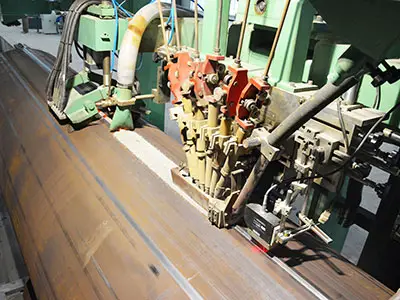
The submerged arc welding process is ideal for important applications in pipelines, pressure vessels and tanks, rail manufacturing and major construction. It has the simplest single wire form, twin wire structure, tandem twin wire structure and multi-wire structure.
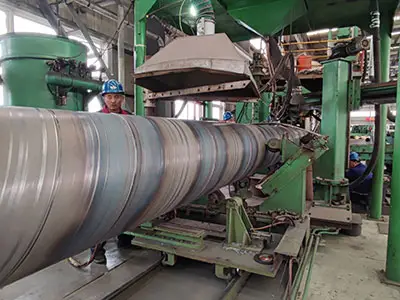
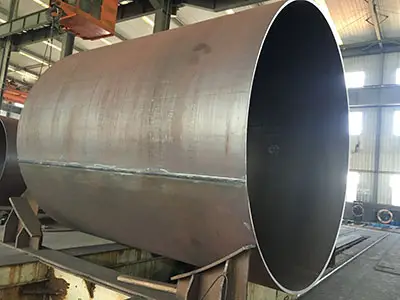
The submerged arc welding process is suitable for the requirements of heavy industrial applications such as pipelines, pressure vessels and tanks, locomotive manufacturing, and heavy construction/excavation. It is very suitable for industries that require high productivity, especially those involving welding of very thick materials, and can benefit a lot from the submerged arc welding process.
Its high deposition rate and travel speed can have a significant impact on worker productivity, efficiency and production costs, which is also one of the key advantages of the submerged arc welding process.
Other benefits include: welds with excellent chemical composition and mechanical properties, minimal arc visibility and low welding fumes, improved working environment comfort, and good weld shape and toe line.
Submerged arc welding is a wire feed mechanism that uses granular flux to separate the arc from the air. As the name implies, the arc is buried in the flux, which means that when the parameters are set, the arc is invisible with a layer of flux flowing out later. The wire is fed continuously by a torch that moves along the weld.
The arc heats and melts a section of the wire, part of the flux and the parent material to form a molten pool, which condenses to form a weld covered with a layer of welding slag. The thickness range of the welding material is 1/16"-3/4", and can be welded with 100% penetration in a single pass. If the wall thickness is not limited, multiple passes can be welded, and the weld is properly pre-treated and the appropriate welding wire and flux combination is selected.











 English