

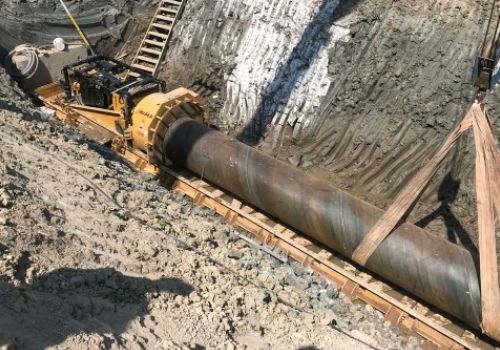
Are you struggling to find exact pipe dimensions for your construction site? Delays cost your company money. I will show you how to select the right sizes easily. SSAW steel pipe sizes typically range from 16 to 100 inches in outer diameter. Wall thicknesses run between 6mm and 25.4mm. You can order custom dimensions for specific pressure, fluid flow, and structural support needs in large-scale engineering projects.
Do not skip the details below. Read this guide to see the full size chart and avoid common purchasing mistakes.
Picking the wrong pipe size causes major flow issues. Your water system might fail under pressure. You need to match the outer diameter to your specific application. Choose 16 to 36-inch pipes for municipal water and medium-pressure gas lines. Select 40 to 100-inch pipes for high-pressure trunk lines and offshore jackets. Pipe size dictates flow rate capacity and installation space requirements.
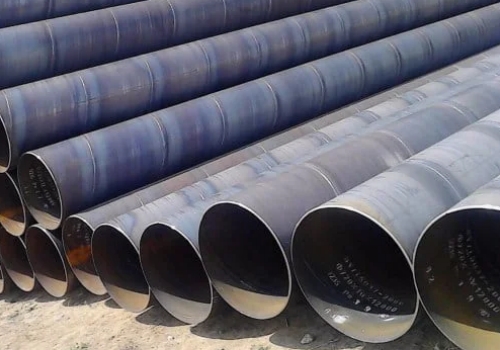
Small to medium pipes measure 16 to 36 inches in outer diameter. We see these sizes most often in municipal water supply systems. They also work well for low-pressure oil and gas pipelines. Their relatively small size makes them easy to handle. Workers install them quickly on small construction sites. Medium pipes balance strength and material costs perfectly. Many builders use them for structural framing. Bridge supports often require these dimensions. I always recommend these sizes for standard urban infrastructure projects.
Large pipes range from 40 to 100 inches in outer diameter. You need these larger sizes for high-pressure oil and gas trunk lines. They are also necessary for large-scale water drainage projects. Larger inner diameters allow for higher flow velocities. They transport massive volumes of fluid over long distances. I recently supplied 72-inch SSAW pipes for a major water diversion project in Africa. Our company handled the production and international shipping smoothly. This large size is also common in offshore platform jacket structures. We custom-make these extra-large pipes to meet your exact project specifications.
I use this basic table to match applications with sizes. You can use it as a quick reference for your next order.
| Application Scenario | Recommended Outer Diameter (mm) | Recommended Wall Thickness (mm) |
|---|---|---|
| Urban Water Supply Branch | 219 - 406 | 6 - 8 |
| Urban Water Supply Main | 508 - 1020 | 8 - 14 |
| Oil and Gas Gathering | 219 - 610 | 6 - 12 |
| Bridge Engineering | 610 - 1220 | 10 - 20 |
You need precise numbers to calculate material costs. Guessing pipe dimensions leads to serious budget overruns. This standard chart gives you the exact measurements you need. Our standard chart covers outer diameters from 219.1mm up to 3048mm. Recommended wall thicknesses range from 6.0mm to 40.0mm. Common steel grades include standard Q235B, Q345B, and API 5L X42 through X65.
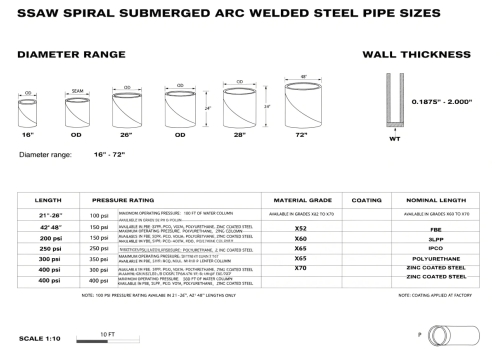
I use a standard table to help EPC buyers select the right pipe. You must check the outer diameter. You must check the recommended wall thickness. We produce these standard sizes at Centerway Steel.
| Outer Diameter (mm) | Inch | Wall Thickness (mm) | Common Steel Grades |
|---|---|---|---|
| 219.1 | 8 | 6.0 - 10.0 | Q235B, Q345B, X42 |
| 406.4 | 16 | 6.0 - 16.0 | Q235B, Q345B, X42-X52 |
| 610.0 | 24 | 6.0 - 25.4 | Q235B, Q345B, X42-X60 |
| 914.0 | 36 | 8.0 - 25.4 | Q235B, Q345B, X42-X65 |
| 1219.0 | 48 | 9.5 - 30.0 | Q235B, Q345B, X42-X65 |
| 1620.0 | 64 | 12.0 - 30.0 | Q235B, Q345B (Custom) |
| 2540.0 | 100 | 16.0 - 35.0 | Q235B, Q345B (Custom) |
Different steel grades serve different purposes. All spiral pipe manufacturers can produce Q235B and Q345B. These basic materials work well for water supply. They work well for general fluid transport. Mainstream manufacturers produce X42 to X52 grades according to API 5L standards. These are common for export oil and gas projects. Capable manufacturers can produce X56 to X65 grades. These grades require strict API 5L PSL2 certification. Very few companies can produce X80 and above. The SSAW process faces technical limits with high-grade steel. Large-diameter high-pressure pipelines usually use straight seam submerged arc welded pipes instead. You must also consider special coatings. We recently shipped 3PE coated pipes to a port construction project in Oceania. You need to confirm production capacity with us early.
Many buyers ignore operating pressure when ordering pipes. This simple mistake causes dangerous pipeline bursts. You must evaluate fluid flow and total costs before you order. Four main factors dictate your final dimensions. You must evaluate the required fluid flow rate. You must check the operating pressure. You must know the specific application type. You must consider the overall project budget.

The required flow rate determines the minimum diameter of the pipe. Larger diameter pipes handle higher flow rates easily. They cost more money. They require more installation space. The operating pressure determines the required wall thickness. Higher pressures require thicker pipe walls. Thick walls ensure the pipe can withstand the pressure without bursting. I always tell buyers to check the exact pressure requirements. You do not want to buy a thin pipe for a high-pressure system.
The specific application changes your size selection. Structural pipes need different sizes than fluid transport pipes. Structural pipes prioritize stiffness. They prioritize section modulus. Fluid transport pipes prioritize pressure resistance. The cost of SSAW steel pipes is a major consideration for EPC contractors. Increasing the pipe diameter raises your material costs. A larger diameter reduces energy consumption for the transported medium. You must compare these costs carefully. You want to save money for your company. I can help you find the best balance.
You must compare SSAW pipes with other steel pipes. Electric resistance welded pipes are a common alternative for small diameters. We call them ERW pipes. Manufacturers form ERW pipes by extruding steel strips after heating the edges. ERW pipes offer high dimensional accuracy. They have low manufacturing costs. They work well for mechanical parts under 24 inches. SSAW pipes provide great dimensional flexibility. The continuous spiral weld seam allows for massive diameters. A 24-inch outer diameter is the normal dividing line. You should choose ERW pipes for sizes under 24 inches. You should choose SSAW pipes for sizes over 24 inches.
| Feature | SSAW Pipes | ERW Pipes |
|---|---|---|
| Best Outer Diameter | Over 24 inches | Under 24 inches |
| Manufacturing Cost | Medium | Low |
| Dimensional Accuracy | Good | Excellent |
| Main Application | Large Fluid Transport | Small Mechanical Parts |
We supply high-quality pipeline products for global EPC projects. You now understand how to select correct SSAW steel pipe sizes. Contact Centerway Steel for your next project today.











 English