

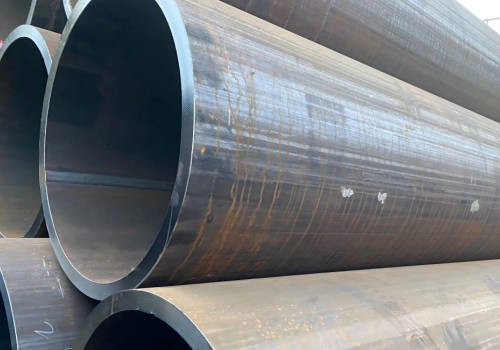
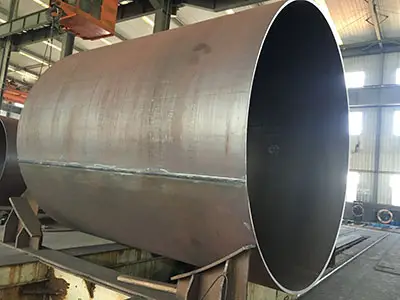
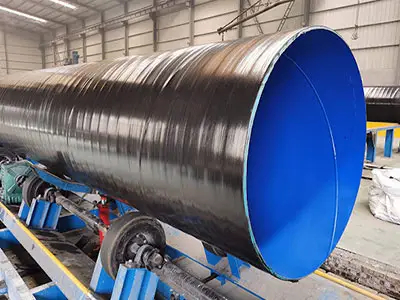
Are you confused by the various acronyms in the steel pipe industry? Choosing the wrong pipe type for high-pressure projects can risk safety and blow your budget. Let me clarify this for you. LSAW stands for Longitudinally Submerged Arc Welding pipe. The LSAW pipes definition refers to a pipe made from a single steel plate, rolled into a tube, and welded with a double-sided submerged arc process. This method creates a straight seam, offering high pressure resistance for critical oil and gas transmission.
Understanding the basic definition is just the start. To truly make the right purchasing decision for your EPC projects, you need to understand how we manufacture these pipes and where they fit best.
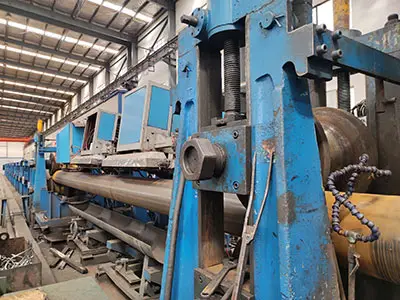
Manufacturing quality determines the safety of your entire pipeline. If the forming process is poor, the pipe will have internal stress and defects. Here is how we ensure structural integrity. The manufacturing process is the core of the LSAW pipes definition. We primarily use UOE and JCOE molding methods. UOE involves U-forming, O-forming, and mechanical expansion. JCOE bends the plate in a J-C-O sequence. Both methods ensure the pipe meets strict straight seam strength requirements.
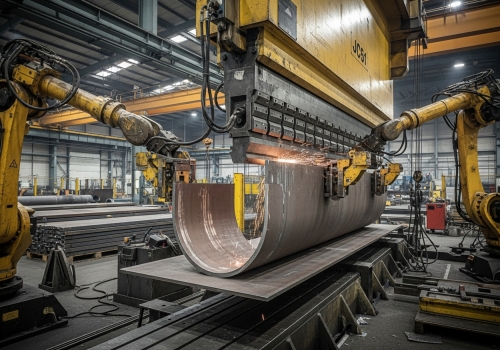
To really understand the quality of the product, we need to look at the "How." At Centerway Steel, we see the molding process as the most critical step. The LSAW pipes definition relies on using a single steel plate as the raw material. This is different from other pipes that use steel coils. There are three main molding methods you will encounter in the market. Each has a specific role in shaping the steel plate into a pipe blank.
1. UOE Method: This is a classic high-speed method. First, we pre-bend the edge of the steel plate. Then, a massive press forms it into a "U" shape. After that, another press forms it into an "O" shape. Finally, we weld it inside and outside.
2. JCOE Method: This is very common for thick-walled pipes. We press the steel plate to make a "J" shape, then a "C" shape, and finally an "O" shape. This progressive bending allows us to handle very thick plates.
3. HME Method: This uses a mandrel rolling method to form the "C" and "O" shapes. A crucial part of all these processes is Mechanical Cold Expansion. After welding, we expand the diameter of the pipe slightly. Why do we do this? It reduces the internal stress of the steel pipe. It makes the stress distribution uniform. This prevents stress corrosion cracking during use. It also ensures the dimensions are extremely accurate, which helps your team weld them easily on-site. Here is a simple comparison of the forming steps:
| Feature | UOE Process | JCOE Process |
|---|---|---|
| Forming Steps | U-shape $\rightarrow$ O-shape | J-shape $\rightarrow$ C-shape $\rightarrow$ O-shape |
| Production Speed | High | Moderate |
| Flexibility | Good for large batches | Good for various sizes |
| Key Benefit | High efficiency | Excellent for thick walls |
Mismatched specifications can cause severe installation delays and failures. You need pipes that fit your design pressure and environmental conditions perfectly. I will list the standard parameters. LSAW pipes feature large diameters (up to 1422mm) and thick walls (up to 26.4mm). They offer high ductility and tight sealing. These features allow them to meet API 5L standards, making them suitable for low-temperature and high-pressure environments.
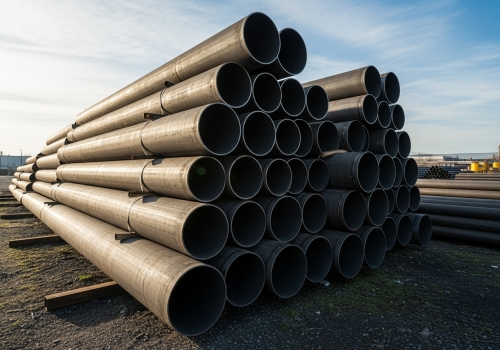
As a purchasing manager, you deal with data sheets every day. The technical parameters of LSAW pipes are quite specific. Because we use heavy steel plates, we can achieve specifications that other methods cannot match. Based on the LSAW pipes definition, the longitudinal weld allows for significant wall thickness. Here are the typical ranges we handle at Centerway Steel:
· Diameter: We produce straight seam submerged arc welded pipes with diameters from Φ406.4mm up to Φ1422.4mm. This covers most large-scale transmission needs.
· Length: The standard length can go up to 12.2 meters. This length is efficient for transportation and reduces the amount of field welding required. Key Features Breakdown:
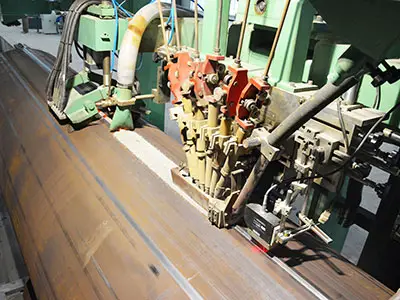
1. Weld Quality: The inner and outer welds use submerged arc welding. This allows for deep penetration and a solid bond.
2. Testing: The straight weld is very easy to test. We can perform non-destructive testing (NDT) during production. Your team can also easily perform NDT in the field. This is a huge advantage over spiral welds.
3. Versatility: We can produce small diameter pipes with thick walls, or large diameter pipes with thick walls. This range covers everything from structural supports to high-pressure gas lines. We strictly follow product standards like ISO3183-3, API Spec 5L, and GB9711. Since we export to over 100 countries, we ensure our certifications (ISO 9001, CE, DNV, etc.) meet your local requirements.
Choosing the wrong pipe for high-pressure zones is dangerous and illegal. You cannot afford leaks in urban areas or difficult subsea environments. Due to the robust LSAW pipes definition, these pipes are often mandatory for Class 1 and Class 2 areas. This includes high-altitude zones, seabeds, and densely populated cities where safety and reliability are the absolute priority.
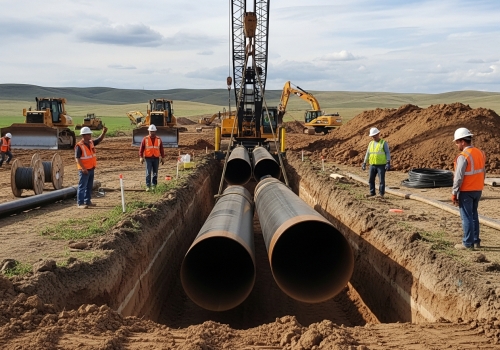
When I talk to clients from Fortune 500 companies like CNPC or Shell, the conversation always turns to safety and reliability. This is where LSAW pipes shine. The manufacturing process we discussed earlier—specifically the cold expansion—gives these pipes excellent toughness and plasticity. This means they can withstand high pressure without cracking. They are also resistant to low temperatures and corrosion. Primary Application Areas:
· Oil and Gas Pipelines: This is the biggest use case. For long-distance pipelines, specifically in "Class 1 and Class 2" areas, LSAW is the designated choice. These are areas that are hard to access or have high populations. You do not want a pipe failure here.
· Offshore and Seabed Projects: The high pressure resistance makes LSAW ideal for deep-sea lines. The straight seam is less likely to suffer from stress defects compared to spiral pipes in these conditions.
· Structural Construction: We supply these for piling in coastal construction, airport construction, and heavy building frameworks. The thick walls provide immense load-bearing capacity.
· Energy Facilities: You will find these pipes in thermal power generation and hydropower stations. At Centerway Steel, we have supplied these products for urban pipeline networks and petroleum refining. The logic is simple: if the environment is harsh, or the consequence of a leak is catastrophic, you choose LSAW. It offers the best balance of strength, precision, and ease of inspection.
LSAW pipes offer superior strength and precision for critical infrastructure. At Centerway Steel, we provide top-quality LSAW solutions globally. Contact us today to secure reliable pipes for your next project.











 English