

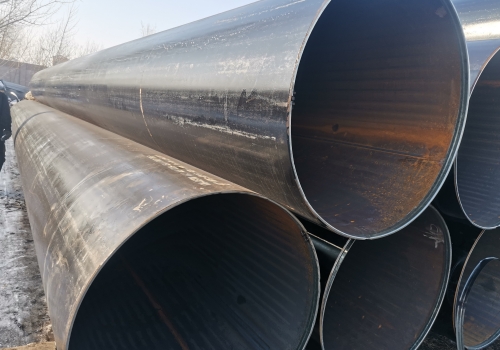
Are you struggling to find a steel pipe that can truly handle high pressure and large diameters for your construction project? Pipeline failures can cause massive delays and cost millions, so choosing the right specifications is a critical task for any purchasing manager. A longitudinal submerged arc welded steel pipe, commonly known as LSAW, is a high-strength pipe made from steel plates. It is produced by bending the plate and welding the seam on both sides. This pipe is ideal for oil, gas, and structural projects requiring large diameters and thick walls.
Many people in the industry get confused by the different acronyms and welding methods. I understand this confusion because I have worked in the steel pipeline industry for a long time. Today, I want to clear up this confusion. I will explain everything you need to know to make the best decision for your company.
It is vital to understand the basic definition before we look at the technical details. If you know the basics, you can avoid buying the wrong product. The longitudinal submerged arc welded steel pipe is a specific type of pipe manufactured by molding steel plates and welding them longitudinally. The welding process uses a submerged arc method, which protects the weld from atmospheric contamination, resulting in a very strong and consistent bond.
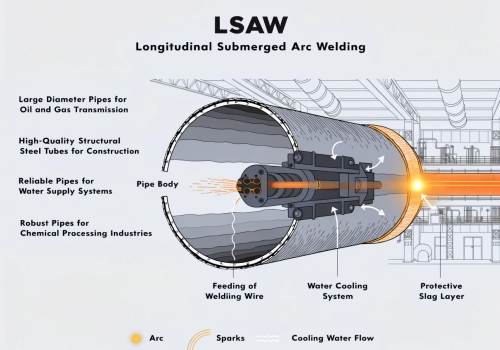
To truly understand this product, we need to look at how it is made and why it is special. The name itself tells you a lot. "Longitudinal" means the weld seam runs straight down the length of the pipe. This is different from spiral pipes. "Submerged Arc" refers to the welding technique. In this process, the arc is submerged under a layer of flux. This prevents sparks and spatter, and it stops air from weakening the weld. In my experience at Centerway Steel, I have seen that this method produces the highest quality welds. The pipe starts as a flat steel plate. We press it into a tubular shape. Then, we weld it from the inside and the outside. This double-sided welding ensures full penetration. It makes the seam as strong as the base metal. One major advantage is the "Cold Expansion" process. After welding, we expand the pipe mechanically. This makes the dimensions very accurate. It also reduces the internal stress of the steel. Because of this, a longitudinal submerged arc welded steel pipe is the top choice for high-pressure environments. It is often used in oil and gas transmission, offshore platforms, and heavy construction structures. It offers a level of safety that other pipes cannot match.
You might be wondering if you can use a cheaper alternative like ERW pipe. Cost is always a big factor in procurement, but performance must come first. ERW (Electric Resistance Welded) pipes are made from steel coils and use high-frequency current to heat the edges. LSAW pipes use steel plates and adding welding material. LSAW is stronger and available in larger sizes, while ERW is cheaper and faster to produce for smaller diameters.
This is the most common question I get from purchasing managers. "Why is the price gap between ERW and LSAW around 15% to 25%?" The answer lies in the raw materials and the process. ERW pipes start as hot-rolled steel coils. This allows for continuous, fast production. It is like an assembly line that never stops. This keeps the cost low. However, coils have limits. You generally cannot make an ERW pipe thicker than 25mm or wider than 660mm. Also, the weld in ERW does not use filler metal. It relies on the heat of the steel itself. While modern ERW is good, it can sometimes have issues with corrosion at the weld line if not treated perfectly. On the other hand, a longitudinal submerged arc welded steel pipe uses individual steel plates. This is a slower process. We cannot run a continuous line like with ERW. But, plates allow us to go much bigger. We can produce thicknesses up to 40mm or more, and diameters up to 1422mm. The welding uses filler wire, which makes the joint incredibly tough. Below is a table to help you compare them easily:
| Feature | ERW (Electric Resistance Welded) | LSAW (Longitudinal Submerged Arc Welded) |
|---|---|---|
| Raw Material | Hot Rolled Steel Coil | Hot Rolled Steel Plate |
| Max Diameter | Usually up to 660mm (26 inches) | Up to 1422mm (56 inches) |
| Max Thickness | Approx. 25mm | Approx. 40mm+ |
| Welding Material | None (Base metal fusion) | Welding Wire added |
| Production Speed | High (Continuous) | Low (Piece by piece) |
| Cost | Lower | Higher (15-25% more) |
| Main Use | Low/Medium pressure, Water, Gas | High pressure, Oil, Heavy Construction |
If your project involves high pressure or needs very thick walls, the extra cost of LSAW is necessary for safety.
Once you decide to buy LSAW, you will see terms like UOE and JCOE. Does it matter which one you choose for your project? UOE and JCOE are two different ways to bend the steel plate into a pipe shape. UOE presses the plate into a "U" then an "O" shape. JCOE bends the plate progressively in steps (J-C-O). Both produce high-quality pipes, but JCOE is more flexible for different sizes.
The manufacturing method affects the stress in the pipe and the accuracy of the shape. Let me break down these acronyms for you. UOE Method: This is a very fast method for making longitudinal submerged arc welded steel pipe.
1. Pre-bending: The edges of the plate are bent.
2. U-Press: A huge press pushes the center of the plate down, creating a U-shape.
3. O-Press: Another press closes the U into an O-shape (a tube).
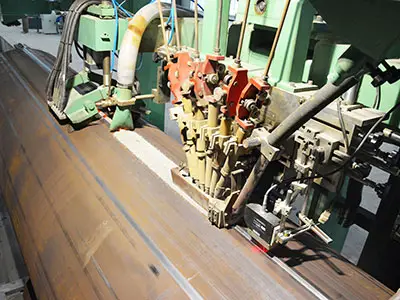
4. Welding: We weld the inside and then the outside using up to four wires.
5. Expansion: A mechanical expander pushes from the inside out to ensure the pipe is perfectly round. JCOE Method: This method is becoming very popular in China.
6. Forming: A machine presses the plate many times. First, it bends one half into a "J". Then it bends the other half into a "C". Finally, it closes it into an "O".
7. Welding: Similar to UOE, we use multi-wire submerged arc welding.
8. Expansion: We also use cold expansion here to release stress. There is also the HME method (rolling method), but UOE and JCOE are what you will see most. The UOE process is faster but requires expensive molds for every size. The JCOE process is slower but can make many different sizes without changing huge molds. For you as a buyer, both are excellent. The most important step in both is the "Cold Expansion." This step ensures the pipe is dimensionally accurate. It also eliminates the internal stress caused by the heat of welding. If a manufacturer skips this step, the pipe might warp or fail under pressure. At Centerway Steel, we ensure all our LSAW pipes undergo rigorous expansion and testing.
Finding a supplier is easy, but finding a partner who understands quality and delivery is hard. How do you filter through the noise? You should look for a supplier with integrated production and global experience. Check for ISO certifications and the ability to handle third-party inspections like SGS or TUV. A good supplier offers a one-stop solution, including fittings and logistics, to save you time and risk.
I have been in this industry since 1996. I know the challenges you face. You need the pipe to arrive on time, and it must pass inspection. First, check the raw material source. A longitudinal submerged arc welded steel pipe is only as good as the steel plate it is made from. Ask your supplier where they get their plates. Top suppliers work with major steel mills to guarantee chemical composition. Second, look at testing capabilities. A reliable factory must have:
· Ultrasonic Testing (UT): To check the plate and the weld for hidden cracks. We can do 100% scanning.
· Hydrostatic Testing: To fill the pipe with water and pressure test it. In China, there are fewer manufacturers of high-quality LSAW pipes compared to other types because the equipment is expensive. It can be difficult to purchase small quantities or specific odd sizes. This is where Centerway Steel helps. We integrate resources. We do not just sell you a pipe; we handle the complex sourcing. We have supplied Fortune 500 companies like Shell and CNPC. We understand that paperwork, certifications (like CE, API, ISO), and shipping are just as important as the steel itself. When you choose a supplier, ask about their "One-Stop" capability. Can they also supply the matching valves and fittings? If they can, it reduces your management workload significantly.
To summarize, a longitudinal submerged arc welded steel pipe is your best choice for high-pressure, large-diameter projects. While it costs more than ERW, its strength, reliability, and manufacturing quality make it essential for critical infrastructure. Choose a supplier like Centerway Steel who guarantees quality through rigorous testing.











 English